Wednesday, September 22, 2010

Ow

     Yay! I have an ear infection! At least I hope it's an ear infection. If not, then something pretty gnarly is going on inside there.

     So yeah, I haven't done any work on the kit today or most of last night. Shit hurts, man. But I did take my last final exam today. I don't know the exact score yet, but I was told it looked like a mid-to-high A. I scored 100% on my theory final. I don't know what my grade is for my Pro Tools final, but I know I did good. I'll have to call in a week to get grades for my Pro Tools and SSL finals. So fuck yeah! All I have left to do is an exit interview.

     I'll have that drum shit finished this weekend. I won't be working on it tomorrow for sure because of my ear. I have a doctor's appointment Friday, but hopefully it'll be feeling a little better by then. I gotta teach my first class on Saturday, so I'll come home and finish the drums Saturday night and Sunday morning.

     I did, however, make some snazzy skins for the kit. I figured I might as well do something productive even if I can't listen to stuff. This is sort of what it'll look like when it's all collapsed and everything is hidden, except the labels will be different... something other than "Button 1" and "Rotary 3"... and everything will be labeled different on the cymbals. That's just a preset I loaded to test the skin with. I'll end up putting tuner knobs for individual toms, the kick and snare, a knob to tighten the heads, to choke the cymbals, and a bunch of shat like that.

     So I did decide I'm gonna add effects. Not much though. Just some tape and tube emulation, and 1 really nasty sounding distortion chain. Not doing any time-based effects.

Monday, September 20, 2010

Making a Kit - Pt. 4: The Sequel to Part 3

     So, after getting my Reason session all nice and ready to go, I moved into Logic. I decided that I was gonna totally bullshit something and see if it worked out. Here's the story.

     See, when I recorded these drum samples, it was at the end of a session. Me and my cousin had been tracking drums for one of our songs. Well, during the setup for that session, I ran into a bunch of problems. A bunch of mic stands all around the school were broken (because assholes try to tighten them way too much), so I had to keep running around and swapping out mics stands. Also, one of the dude's from my class kept barging in the studio and whining about some bullshit (basically, that he was having to work his ass of just to slip by since he slacked off like a dumbass for the previous few months). 

     So I ended up being set back by about half an hour. We really had to rush, because we were recording a 13 minute song and I had no idea how long it would take to gets some good takes out of my cousin. So, after all the mics were set up, I was doing level check, and I noticed that the trash mic wasn't putting out signal. I ran out to the live room and made sure it plugged in good. It was, so it had to be a bad cable. Well, my cousin was already pissed off a little and so was I, we didn't have much time, and I kinda just didn't give a fuck, so I just let it slide (only because it was a personal project).

     Anyways, the point is that I didn't have a trash mic. A trash mic is pretty much just a mic that goes behind the drummer and gets compressed to hell and back. There's a more lengthy explanation of it my Compression post (very bottom).

     Well after everything was recorded, I decided that I really wanted that trash mic. Especially once I started putting together this kit. Now that I'm out of school, I won't have access to their awesome mics anymore. I also won't have access to that specific drum kit, or more importantly, that live room... or that SSL... not until I go back for my final semester of music business classes next year. 

     So I wanted this kit to really be a straight up replica of the same exact signals I got from that kit, recorded with those mics, running through that console. Well, I really like using a trash mic, and I didn't have one. So the only solution was to fake one. 

     In order to do this, I had to somehow use signals from all those different mics and make them sound like one microphone behind the drum kit, about 7 feet high. So I'm having to fuck with time of arrival and also make some really nice condensor mics (which were only used for overheads, hat, and ride) sound like a fucking SM58. 
     Ok, so here's what I did. I just took the signal from the spot mics of each drum and made a virtual replica of the kit using Logic's binaural panner. I had to do it from the perspective of that SM58. It was up high facing directly between the high an mid toms. So I had to pan everything out left and right accordingly. Once that was done, I had to set their vertical positions. So obviously the kick was down low, the snare was sorta low, the cymbals were high, blah blah. Then I had to make it seem like the mic was a few feet behind the kit. So I figure that distance from the mic stand to the front of the kick drum was about 5 feet or so (which just happens to about 1.5 meters, Logic's default room radius). So, considering this mic would actually be picking up the back of the kick, I didn't put it all the way to the edge of the "room". 

This picture shows all my fake drum positions. The center is where the trash mic would be. I don't know why that china cymbal is back so far... I don't remember doing that, so I'm assuming I accidentally moved it when I was taking the screenshots of this shit.


    So all that shit is set up. Then I had to route all those signals to an aux with the binaural post processing, and then send that to another aux that converted the signal to mono. Since I'm just trying to create signal for one mic, I need a mono signal, but I had to convert it to mono after the binaural aux. This way, the binaural aux would still be a stereo channel and be able to recreate a fake room with the binaural panner. I needed the stereo signal to create the 3D space, then the mono aux signal is technically what represents the trash mic. 
  

     I also added some gates to the channels which had signal from condensor mics. The threshold was all the low and the release was long. I just needed a couple of milliseconds of attack to take those condensors and give the slower response of a dynamic mic. I also slapped on an EQ to take out a tiny bit of high end. I honestly didn't EQ as much as I should have, but none of this shit was perfect anyways. It was all experimental and obviously gonna be flawed, so I figured I'd just barely effect the beautiful signal of those condensors and leave them sounding the way I liked them instead of fucking them up. 

    So everything was set up. All that was left for me to do was pull in the samples from the spot mic from each drum, at each velocity, and bounce them one at a time. In total I had to do 63 samples.
     So yeah, it was a pain in the ass, and no, this can't replace the real thing, but I did get a pretty accurate time of arrival for each drum, and I did get a pretty decent simulated trash mic. But in the end, it doesn't matter if it's a little fucked up. It's just gonna get the shit compressed out of it and be put really low into the mix, so whatever. It's better than nothing, and I think it sounds pretty damn accurate.

     The next post will have some audio examples of the kit. There are probably only two more parts to this series of posts, then I'll finally be doing talking about something else.

Saturday, September 18, 2010

Making a Kit - Pt. 3: Making your Head Asplode

     Before I begin, I'm gonna list a few terms. If anyone actually reads this and doesn't know too much about Reason or microphones, I'd like it to make a little bit of sense.

     Spot mic: A microphone placed very close to the source. With drums, a spot mic is the 
                     primary mic for the drum it is closest to.
     NN-XT: A software sampler within Reason.
     Sampler: ....used to play samples of shit
     Rewire: Some bullshit that magically allows Reason to route its signal to other DAWs
     DAW: Digital audio workstation 

     I think that will suffice.

     I chose to use Reason to house the kit. Normally, I would have used Logic's ESX24, but since this was going to be a super complex kit, I chose Reason. Another reason I chose Reason... <_< .... was so I could use so I could use it on my Mac or my PC. And the main benefit is that it can be Rewired to Pro Tools, Logic, Ableton, Cubase, Audition, Fruity Loops, or whatever the fuck else uses Rewire!

     I set it up so that Reason would just be the host for the kit, without doing any kind of mixing and without any effects. The main purpose of this kit was to give me a realistic drum mixing experience for times when I don't have access to a real kit or a drummer. I like being able to make a thousand decisions and really mold the kit. Don't get me wrong, I'm a huge fan of Battery and I love a lot of the kits that come with Reason and Logic, but whenever I use those, it's when I want the drums to sound a little fake. A little too perfect to be real.

     So I haven't loaded any of the samples into Reason, but I went ahead and made my template for the kit and routed everything out. I'm using NN-XTs to play the samples. There are 11 NN-XTs. Each one is used for a different drum (kick, snare, hat, ride, etc). So the Kick NN-XT has 9 kick hits, each at a different velocity, and each with samples of the signals from 14 microphones.

     There are also 12 mixers. Each NN-XT represents a drum, whereas each mixer represents a microphone. Two of them are being used in stereo (one for overheads and one for room mics), so they represent two mics each. So in total, there were 14 microphones. So for example, the snare drum is mic'd  with an SM57. When the drummer hits the snare, the SM57 obviously picks up the snare. But when the drummer hits a tom, the SM57 also picks up that.

     For this reason, there is a mixer that specifically represents that SM57 microphone. So it will receive all the snare drum samples recorded from the SM57, but it will also receive the samples of every other drum recorded with the SM57, even though it wasn't the primary microphone for those other drums.

     The same goes for the kick drum mic, an AKG D 112. The mixer that represents this mic will receive all the kick drum samples recorded with the D 112, but it will also receive all the other samples of all the other drums that were recorded with the D 112.

     So the kick drum's NN-XT, for example, will route out to 12 mixers (14 mics). Each of those mixers, also receiving signal from other NN-XT's, will feed into another DAW, such as Logic, onto their own individual channel strips.

     There are also 4 additional 6-channel mixers. They are being used to act as spot mics for 3 cymbals and sticks. None of these cymbals actually had separate spot mics. I'm just using the signal from the closest mic to act as a spot mic. I don't use spot mics on cymbals because the overheads pretty much are spot mics, they just happen to also make the rest of the kit sound brighter.

     Take the crash cymbal, for example. The closest mic to it was the left overhead mic. So when the crash cymbal is routed to the Overhead Mics mixer, the signal from the left overhead is split into two signals, A and B. A goes to the Overhead Mics mixer's left channel input, like normal, while B goes to a separate mixer. This mixer is getting the same signal, but it gives me the ability to turn up the crash cymbal as it was recorded with the left overhead mic without turning up all the other drums as they were recorded with left overhead mic, and without turning up the crash cymbal as it was recorded from all the other mics.

     That's something that I can't really do when I'm recording a live drummer, but since I have the option to do it now, I'm fucking doing it! I don't actually have to use separate mixers for those spot mics and the cymbals. The B signal could just be routed straight out to Logic, but I like the idea of them having a "home". I wanna be able to look at Reason and see those microphones being represented instead of lost in all the shit.

     ANYWAY, here's a screenshot of the routing I did. That large mixer on top and the small mixer below it won't actually be used. I'm just using them right now while I build the kit so I won't have to have Logic open for the building process. I'll also save a copy of the session with those mixers included. That way I can use it while I'm running Reason in standalone mode (which I never do, though).

Click to enlarge
     So yeah, no effects or mixing, just a source for the drums and a bunch of routing.

     My next post will be about how I fake a trash mic with the binaural panner (surprise surprise) in Logic. I hope this was somewhat interesting.
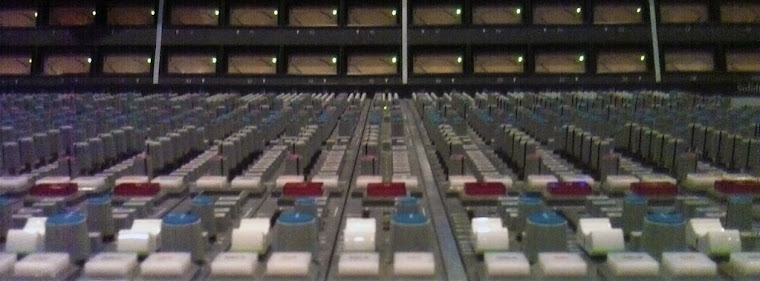
Making a Kit - Pt. 2: Getting Carpal Tunnel Syndrome

     Ok, to summarize part 1, I'm making a sampled drum kit from some live drum samples I recorded a few weeks ago. Each drum was hit 3 times at different velocities (really soft 3 times, soft 3 times, harder 3 times, etc), so there are lots of files to deal with. And not only that, but I'm not just using the spot mic on each drum, I'm using ALL the mics for each drum. I want the bleed.
---------------------------------------------------------------------------------------------------

     Alright, I finally finished all the editing. I had to open up the Pro Tools session and cut up all this shit. I split the regions at each drum hit. I did it all manually. Strip Silence wasn't accurate enough for this in some places, so I figured I'd just do it all manually. It sucked ass, but if I had used Strip Silence, I would have had to go back and check each hit, and probably do some minor tweaks to a lot of them anyways.

  
     If you ever do this, just make sure the drum tracks are grouped. I probably would have just killed myself if grouping didn't exist. Shit would have taken days.

     Then I had to do some edits to some of the hits. There were minor problems, and I wanted to keep the samples, so I just edited them instead of trashing them.
  
     So once each the samples were edited and faded right, I needed to convert them to new files. To do this I just consolidated each region. The key command is Shift-Option-3, but you can get to it through the edit menu.


     So when you consolidate, a new file is created. But that caused a problem, because I already had a lot of files in my Audio Files folder (remember this was at the end of a song, in the same session... I don't know why I didn't make a new one), so trying to sort through all that shit would have sucked really bad. To avoid this, I went to the Disk Allocation window and changed all the drum tracks to a new location. This didn't move where the preexisting files were located, but it did direct the new files to a new folder. So I did this before I consolidated the regions.


     So after a few hours of editing, I finally had all my samples. Now I just had to organize them. I left them all in the same Audio Files folder so that they would automatically be renamed (Kick_09.01, Kick_09.02, Kick_09.03, and so on). Since I had a sample from every mic for every hit, I had files labeled as "Kick_09.27" and "Hi Tom_09.27" for a hi hat... so yeah, that could have gotten pretty confusing. As I consolidated regions, I kept track with all the file names in a text document.

     I ended up with 819 samples. I can't imagine how shitty it's gonna be trying to load in and arrange all this shit in a sampler. It's not going to be fun, and it's probably going take take almost a whole day.

EDIT: I forgot to include this. I wanted to give an example of how a tom sounds with all the other mics open. So here's a video of a tom playing with all the mics, then just the single spot mic, and then all the mics again.

     It sounds so much bigger with all the other mics. It's mainly the overheads and room mics that make it sound bigger, but the other mics help too.

A Couple of Plugins

     For those of you that were wanting to do binaural mixing on a PC, here are a couple of other free plugins. I haven't even tried them out, as I'm super busy right now and not on my PC, but I don't know how good they are. They don't claim to do binaural processing since they never use the word "binaural" in the descriptions, but they do say they simulation 3D spacial positioning.

http://www.wavosaur.com/vst/spatial-imaging-plugins.php

     It's the two on the bottom: Prodyspace an Dum Mic Positioner
That other plugin I mentioned in my Binaural With Fruity Loops post looks more trustworthy, but it'd sound too great.

I'll mess with them later and let you now how they are, but I'm not expecting much.


  • p.s. - buy Logic

Friday, September 17, 2010

Making a Kit - Pt. 1: Bitching About It

     Well, yesterday was my last day of class and today was my last seminar. I have finals Monday, Tuesday, and Wednesday. Damn it! I don't want school to be over!

     Anyways, today is the day I begin my quest to build a fuckin sampled drum kit. It wouldn't be so bad or time consuming, but I'm going a little overboard. Instead of just doing it the standard way, I'm sampling each drum from every mic that was used.... I'll explain it more clearly in a second.

     One problem I have with sampled drum kits is that there is a lack of control and a lack of realism. Even though they sampled drums sound awesome, each drum is only sampled with one mic. That's really awesome because you get really clean results. The only problem is that there is no bleed.

     For example, when I record a live kick drum, the mic on the kick drum also picks up everything else the drummer is playing. I have to go back and add a noise gate to remove everything that's being played when the kick isn't being played... so yeah, I am getting rid of the bleed, but if a tom is hit at the same time or immediately after the kick, then that isn't removed with the noise gate.

     I realize that bleed is considered to be an annoying thing (and it is. It's annoying as shit), but it can also be a good thing. It can really add space to the drum mix. Take the hi-hat for example. I don't gate the hi-hat. That means that throughout a song, you hear the kick drum being picked up from the kick mic and the hi hat mic (plus a bunch of other mics). The same goes for everything else. Even a specific drum is gated, there's still gonna be a little bleed every now and then (unless you're gating so much that the drums don't even get a chance to ring out), so I'd like to be realistic and add this into my sampled kit.

     This way, I'll at least be able to have it if I want it. I'll also have the option to completely remove bleed from certain drums with the click of a button. For some, I'll even set a knob to control the amount of bleed. This way, I can have complete control.

     I'm also doing letting the overhead mics pick up everything, not just the cymbals, and I'm also doing room mics.... that's a bitch in and of its self, so needless to say, all the bleed bullshit is going to take forever.

     Right now I'm just cutting up the audio files and organizing them. That's gonna take a while. I really hate doing this shit. I love sampling stuff (but not sampling parts of songs or drum loops... I find that to be rather lame), but I really hate the whole editing process. I love the results though.

     Oh well, I'm gonna go finish doing that. I'll make a post tomorrow about the editing process. It's a pretty dry topic and there's no fun to be had, but there will be good info about how to do this without pulling your hair out.

Wednesday, September 15, 2010

Fudgin Paperwork

     Bleh, currently doing a crap ton of paperwork. My final projects (Sound-to-Picture, SSL, and Neve) are due this Saturday. I already turned in sound-to-picture, so all that's left is to do the fucking paperwork for the SSL and Neve projects. I'm finsihsing the SLL paperwork right now
                                                       (my project partner has the other half)

     So yeah, that pretty much blows. Anyways, I don't know if any of you guys use Logic or Reason, but I was planning on doing a tutorial on how to build a sampled drum kit (with overhead mics and room mics) in Logic's ESX24 or in Reason using the NNXT. Either is fine, although, surprisingly, Reason has one cool feature that Logic doesn't. I'm gonna be making it anyways, using some recordings I did of the school's drum kit, so I figure I can kill two birds with one stone and just do a post about it. If anybody has a preference, let me know. If not, I'll probably use Reason.