Ok, so I'm about to start teaching some audio engineering classes in a few weeks, so I wanna use the next few posts to talk about some things I'll probably end up covering in those classes. I'll be teaching teenagers, so their curriculum or whatever most likely won't involve any of these topics, but I'm sure I'll at least be asked questions related to this stuff.
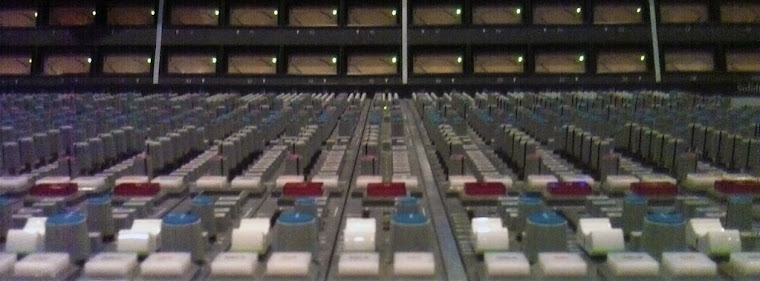
Consoles... I know I spent part of my last post bitching about never being able to afford an SSL or any other awesome console. But I also said I liked not having to deal with the crap that's involved with using a console. As a certain man by the last name of Grau and the first name of Joshua who shall remain nameless said, "I'd rather just go home and do this all in Logic." I too, would rather just go home and use Logic. Lately, (other than on school projects) I've just given up consoles altogether and started mixing totally in-the-box. I do, however, take my sessions into the SSL or Neve studios while mixing, but only so I hear the mix in those specific rooms instead of my bedroom or one of the school's smaller editing suites.
Honestly, if I had unlimited money, I still wouldn't buy a big console. They use up an assload of power, they require you to have the room at a certain temperature to keep them from overheating, require you to go through pain-in-the ass subgrouping unless you have a 200-channel board out in your backyard, they require you to have an expensive-ass Pro Tools rig, they limit you on inserts, they give you limited EQ control (unless you can find 174.61Hz with your ears, and yes, it helps to be that specific sometimes), they limit your number of busses, they require you to document and recall your all of your parameters each session, and a ton of other annoying crap.
Most of those problems can be avoided with a digital board, but it's still just a gigantic representation of what's already in Pro Tools, and it's already digital, so it's not like you can have any kind of audiophile argument to justify having a board. You could also get one of those awesome ICON digital consoles... but congrats on buying a giant mouse.
There is the argument that analog boards give your mix that "warm analog sound," but fuck you, that's just harmonic distortion and even if you want that, they make plug-ins that do that very thing. Sure, a plug-in is never going to precisely replicate the sound of a piece of analog gear, but a piece of analog gear can never precisely replicate the sound of a plug-in, so eat shit. I mean, two pieces of the same kind of analog gear aren't even going to sound exactly the same, because they aren't THE EXACT SAME PIECE OF GEAR! Plus, if you do an entire mix on a Neve, it's not like anyone, even a super-audiophile, can tell what board it was mixed on. These boards' distinctive sounds aren't really that distinctive unless you're the one in the room with it mixing on it.
And if you really want to add that "analog warmth", then you can add it to the entire mix with any small piece of analog gear. It doesn't have to be a giant mixer. Hell, you could even use something with a tube and crank it through to really add some warmth. So don't get me wrong. I'm all for that kind of thing. I just don't have a specific way I think things should be done. I believe in experimenting and trying to do something different with each song, whether you're using plug-ins, running an entire mix through a preamp, blasting a signal through a speaker into a washing machine and recording it with the crappiest mic you can find, or doing all three :D
So, to clarify, I'm not saying you can totally model the sound of a board with digital crap, because those tiny differences do add up by the end of a mix, but my point is, as long as it sounds good, why does it matter what equipment was used? And I don't mean to rag on boards. I do love them and it feels awesome to work on one, but in a lot of cases, they are just a huge pain in the ass to work around and nobody (artists or engineers) should have to feel like their mixes were done on a console to be worth a damn.
Please note, when I say that working on a console is a pain in the ass, that doesn't mean I'm not good at it. I'm mainly saying that compared to the quickness and super-flexibility of DAWs, boards can just get in the way sometimes. Sure, you can do a lot of complex stuff in PT and then do the other half with a board... but what's the point? Also note that I do plan on buying a mixer, just not a huge one. All I want is a small one for tracking, and I probably wouldn't use it at all for mixing.
So, to close this out, I wanna say that I freakin love that SSL at school and that it does sound great, but if you're the type of person that thinks that things have to be done a certain way or with certain gear, then fuck you.
Friday, September 3, 2010

Tuesday, August 31, 2010
Money is dumb and I hate it
I was doing more work on my assignment which requires me to design a studio, make a list of all expenses, and write a mini-business plan... well apparently opening a "modest" studio costs enough money to make me want to die (a little). I could totally go way cheaper, but I guess my standards are a little too high :(
I know you'd realistically have to get a loan, but my credit sucks, so I guess opening a studio is out of the question for me lol. But for someone who has some money or the ability to get a loan, it actually doesn't cost too much to open up a decent studio. It would definitely cost twice as much as your car (unless you have a super nice car). But if you don't care about being super snazzy, you could totally open up a nice studio for less than the cost of an SSL.... and I mean an old SSL.
In summary, someone give me a winning lottery ticket. If not, I guess I can accept that there are certain things I'll never have.
Speaking of things I'll never have, here's me using the school's SSL G4000+
 I'm gonna miss that thing so bad. I will admit that I like the convenience of doing everything in-the-box and not having to recall a bunch of settings every time I do a session, but.... it's a freakin SSL! And I doubt any studio that I get a job at would just let me use their SSL in my free time lol
I know you'd realistically have to get a loan, but my credit sucks, so I guess opening a studio is out of the question for me lol. But for someone who has some money or the ability to get a loan, it actually doesn't cost too much to open up a decent studio. It would definitely cost twice as much as your car (unless you have a super nice car). But if you don't care about being super snazzy, you could totally open up a nice studio for less than the cost of an SSL.... and I mean an old SSL.
In summary, someone give me a winning lottery ticket. If not, I guess I can accept that there are certain things I'll never have.
Speaking of things I'll never have, here's me using the school's SSL G4000+

Ze Mono Button
I just wanna say a thing or two about one of the most insanely simple concepts I've learned from the amazing Scott Kieklak. The freakin mono button: Use it! I've been doing mixing for hire for about a year, and you have no idea how much my mixes improved once I got Scott's advice.
I've told people about this before, and they usually just say I'm retarded and argue that "it screws up your stereo image and has nothing to do with how it's gonna be heard and blah blahblahbkdsnsl." Well, all of those people are dumb. Just try it. It's the truth. Unless someone is listening to music with headphones, it isn't going to be very stereo.
If they listen to it through a laptop, a small boom-box (shut up, it's not a lame word), or those little speakers that you plug iPods into, it's gonna be pretty mono. Think about it. Those speakers are uber close together, and most of the time, it's playing from across the room, so there's no stereo information left by the time it reaches you. Not only that, but a lot of radio stations broadcast in mono.
I'm not saying that you should mix your stuff in mono. Just check it in mono. If there are phase issues, you may not hear them until it's in mono. If you pop it into mono and suddenly all your low end drops out, then you have a problem. When you use those stereo synth patches that are all crazy sounding and flippin from hard left to hard right, you need to check that crap too. I've mixed some dude's some and it had a synth like that, but in mono, you could barely hear it. I could only notice it in stereo because it was obviously jumping around, but to a person who has it playing across the room on small speakers, that synth isn't moving.
ALSO, if make something pseudo-stereo by making a fake copy of an instrument by using a super fast stereo delay, it's gonna sound crappy and phasey in mono, so you'd better check it and do what you can to fix it. Even if you make a copy of something in Melodyne, alter it pretty good, then throw it in the opposite speaker, it may end up sounding phasey.
I could ramble on about that for a good while. I just thought about it while I was mixing something just now. I've been doing it for months ever since Scott told me about it, but I just now remembered how big of a difference it makes.
TL;DR - Mix in stereo. Pan all your crap how you want it. Check it in mono. Adjust levels, EQ, or whatever.
NOTE: If you try this with Logic 9, it may not work. The mono button on the Stereo Out doesn't work properly in some copies (if not all) of Logic 9. Just route everything to an aux, then to your Stereo Out. Use the mono button on the aux. In Pro Tools, some plug-ins let you switch the signal to mono, so you could put that on the master fader, but I just send everything a stereo aux first. Then you can just switch the panning between <100|100> and <0|0>. Plus, plug-ins on the master fader in PT are post-fader, so I use an aux first anyways just so I can use pre-fader inserts on my whole mix.
Ok, I'm going to bed. I feel ridiculous for making a blog post about the mono button, but it's a big deal, people.
I've told people about this before, and they usually just say I'm retarded and argue that "it screws up your stereo image and has nothing to do with how it's gonna be heard and blah blahblahbkdsnsl." Well, all of those people are dumb. Just try it. It's the truth. Unless someone is listening to music with headphones, it isn't going to be very stereo.
If they listen to it through a laptop, a small boom-box (shut up, it's not a lame word), or those little speakers that you plug iPods into, it's gonna be pretty mono. Think about it. Those speakers are uber close together, and most of the time, it's playing from across the room, so there's no stereo information left by the time it reaches you. Not only that, but a lot of radio stations broadcast in mono.
I'm not saying that you should mix your stuff in mono. Just check it in mono. If there are phase issues, you may not hear them until it's in mono. If you pop it into mono and suddenly all your low end drops out, then you have a problem. When you use those stereo synth patches that are all crazy sounding and flippin from hard left to hard right, you need to check that crap too. I've mixed some dude's some and it had a synth like that, but in mono, you could barely hear it. I could only notice it in stereo because it was obviously jumping around, but to a person who has it playing across the room on small speakers, that synth isn't moving.
ALSO, if make something pseudo-stereo by making a fake copy of an instrument by using a super fast stereo delay, it's gonna sound crappy and phasey in mono, so you'd better check it and do what you can to fix it. Even if you make a copy of something in Melodyne, alter it pretty good, then throw it in the opposite speaker, it may end up sounding phasey.
I could ramble on about that for a good while. I just thought about it while I was mixing something just now. I've been doing it for months ever since Scott told me about it, but I just now remembered how big of a difference it makes.
TL;DR - Mix in stereo. Pan all your crap how you want it. Check it in mono. Adjust levels, EQ, or whatever.
NOTE: If you try this with Logic 9, it may not work. The mono button on the Stereo Out doesn't work properly in some copies (if not all) of Logic 9. Just route everything to an aux, then to your Stereo Out. Use the mono button on the aux. In Pro Tools, some plug-ins let you switch the signal to mono, so you could put that on the master fader, but I just send everything a stereo aux first. Then you can just switch the panning between <100|100> and <0|0>. Plus, plug-ins on the master fader in PT are post-fader, so I use an aux first anyways just so I can use pre-fader inserts on my whole mix.
Ok, I'm going to bed. I feel ridiculous for making a blog post about the mono button, but it's a big deal, people.
Monday, August 30, 2010
Shameless Advertising
Awesome, I aced my acoustics test! I only have a couple of weeks until finals. I'm gonna miss school.... I won't have "free" access to such good studios anymore :( I'm hoping I win the lottery or something so I can build my own, but I haven't quite figured out the trick to winning the lottery. I am, however, working on a project right now that requires me to fully design a studio with a realistic budget (although it's not very realistic to me, since I'm a poor college student with no credit) and decide what my fees will be and all that good shit.
Speaking of being a poor college student with no credit, I'd like to take a moment to whore myself. I hate to brag, but I do some pretty kickass mixing and mastering, so if anyone happens to need any of that stuff done for a pretty low price, then hit me up! I don't have a website yet (workin on it), but I do have some sample material.
Ok, enough of that. I wish I could have discussed some interesting audio-related topic, but I have a lot of stuff I gotta go do. I've got a project due next week, three huge projects due in 3 weeks, finals in 3 weeks, and I'm also trying to finish a personal project.
Speaking of being a poor college student with no credit, I'd like to take a moment to whore myself. I hate to brag, but I do some pretty kickass mixing and mastering, so if anyone happens to need any of that stuff done for a pretty low price, then hit me up! I don't have a website yet (workin on it), but I do have some sample material.
Ok, enough of that. I wish I could have discussed some interesting audio-related topic, but I have a lot of stuff I gotta go do. I've got a project due next week, three huge projects due in 3 weeks, finals in 3 weeks, and I'm also trying to finish a personal project.
Sunday, August 29, 2010
Acoustics
Since I'm sitting here studying for my acoustics test, I figured I'd say a thing or two about tuning a room. Obviously, if you just listen to music, this probably isn't very important to you and would cost too much money. But for anyone that's mixing, having an acoustically treated room is more important than the speakers you have. What's the point in buying high-dollar speakers if your room is totally skewing everything you hear?
For anyone working on a budget, it really doesn't cost too much money to get a good sounding room. Really, all you need to worry about is the reverb time of your room, adding bass traps, and adding a diffuser. There are some simple formulas for finding out what frequencies you need to work on trapping, but there is a nifty calculator at MCSquared.com that will let you cheat a little. It calculates the axial, tangential, and oblique modes according to the room dimensions you give. Most people will argue that unless you are trying to treat a concert hall, axial room modes with be enough for you to work with.
As for finding the reverb time.... sorry, I don't have a calculator for that. That's some math you're gonna have to do by hand. It's not really that hard, just time consuming. It's also a pain because unless you're straight up building your room, you have to find out the absorption coefficient of whatever materials are already used in your walls, ceiling, and floor. Then you have to find a new material to add that has the right absorption coefficient to compensate for that damage that your pre=existing materials are causing.... it's a pain.
But anyways, if you're interested in it at all, look a dude named Ethan Winer on youtube or go to his site, RealTraps.com (I swear, it's not what you think!). I wouldn't suggest buying his product unless you want a bunch of gawdy panels all over your room, but he has some good videos that will explain how to tune a room. If you really want to make a purchase, I'd suggest Auralex (although it's uber expensive)
If you're really brave, try building all your traps and diffusers from scratch! Anyways, I'm gonna go back to studying.
For anyone working on a budget, it really doesn't cost too much money to get a good sounding room. Really, all you need to worry about is the reverb time of your room, adding bass traps, and adding a diffuser. There are some simple formulas for finding out what frequencies you need to work on trapping, but there is a nifty calculator at MCSquared.com that will let you cheat a little. It calculates the axial, tangential, and oblique modes according to the room dimensions you give. Most people will argue that unless you are trying to treat a concert hall, axial room modes with be enough for you to work with.
As for finding the reverb time.... sorry, I don't have a calculator for that. That's some math you're gonna have to do by hand. It's not really that hard, just time consuming. It's also a pain because unless you're straight up building your room, you have to find out the absorption coefficient of whatever materials are already used in your walls, ceiling, and floor. Then you have to find a new material to add that has the right absorption coefficient to compensate for that damage that your pre=existing materials are causing.... it's a pain.
But anyways, if you're interested in it at all, look a dude named Ethan Winer on youtube or go to his site, RealTraps.com (I swear, it's not what you think!). I wouldn't suggest buying his product unless you want a bunch of gawdy panels all over your room, but he has some good videos that will explain how to tune a room. If you really want to make a purchase, I'd suggest Auralex (although it's uber expensive)
If you're really brave, try building all your traps and diffusers from scratch! Anyways, I'm gonna go back to studying.
Hey
I though I'd share my experiences as an audio engineering student. I never talk about school (or anything audio-related) outside of school. None of my friends seem to understand that audio engineering is more than just pushing up a fader while someone's singing, and my family doesn't seem to have any interest in it unless they're asking "so how much money are you gonna make when you get a job?" or "Are you gonna be able to find a decent job? Maybe you should just try to get a job doing something with computers."
I don't have much to say right now, as I'm studying for an acoustics test and simultaneously doing some edits to a country song I tracked yesterday, which by the way, was a first for me. I've never really been into country music, but I actually like this song. The band came in and had to really rush though the recording because they had somewhere else they needed to be. It was kind of a bare session. We only recorded drums, bass, one acoustic rhythm guitar, an electric lead guitar, and a lead vocal. Near the end of the session, they had time to do one more thing, and thank God they chose to do two more takes of the lead vocal.
I thought it was gonna be tough to make this sound really big, but Melodyne goes a long way. I've got the vocal doubled during the chorus and added some harmonies. I also used Melodyne Editor to double the acoustic guitar, and it turned out surprisingly well. It still sounds a little funky in mono, but as I said, I've also been studying while doing this. I'll actually get crackin on it at school. I'm just doing some minor things now so I can get it out of the way and really make use of the studio for mixing. For the record, I'm usually not the type of guy that turns to Melodyne to fix all my problems. It was really my only option in this case, and it did the trick. But anywho.... I guess I need to finish studying and get to bed.
I don't have much to say right now, as I'm studying for an acoustics test and simultaneously doing some edits to a country song I tracked yesterday, which by the way, was a first for me. I've never really been into country music, but I actually like this song. The band came in and had to really rush though the recording because they had somewhere else they needed to be. It was kind of a bare session. We only recorded drums, bass, one acoustic rhythm guitar, an electric lead guitar, and a lead vocal. Near the end of the session, they had time to do one more thing, and thank God they chose to do two more takes of the lead vocal.
I thought it was gonna be tough to make this sound really big, but Melodyne goes a long way. I've got the vocal doubled during the chorus and added some harmonies. I also used Melodyne Editor to double the acoustic guitar, and it turned out surprisingly well. It still sounds a little funky in mono, but as I said, I've also been studying while doing this. I'll actually get crackin on it at school. I'm just doing some minor things now so I can get it out of the way and really make use of the studio for mixing. For the record, I'm usually not the type of guy that turns to Melodyne to fix all my problems. It was really my only option in this case, and it did the trick. But anywho.... I guess I need to finish studying and get to bed.
Subscribe to:
Posts (Atom)